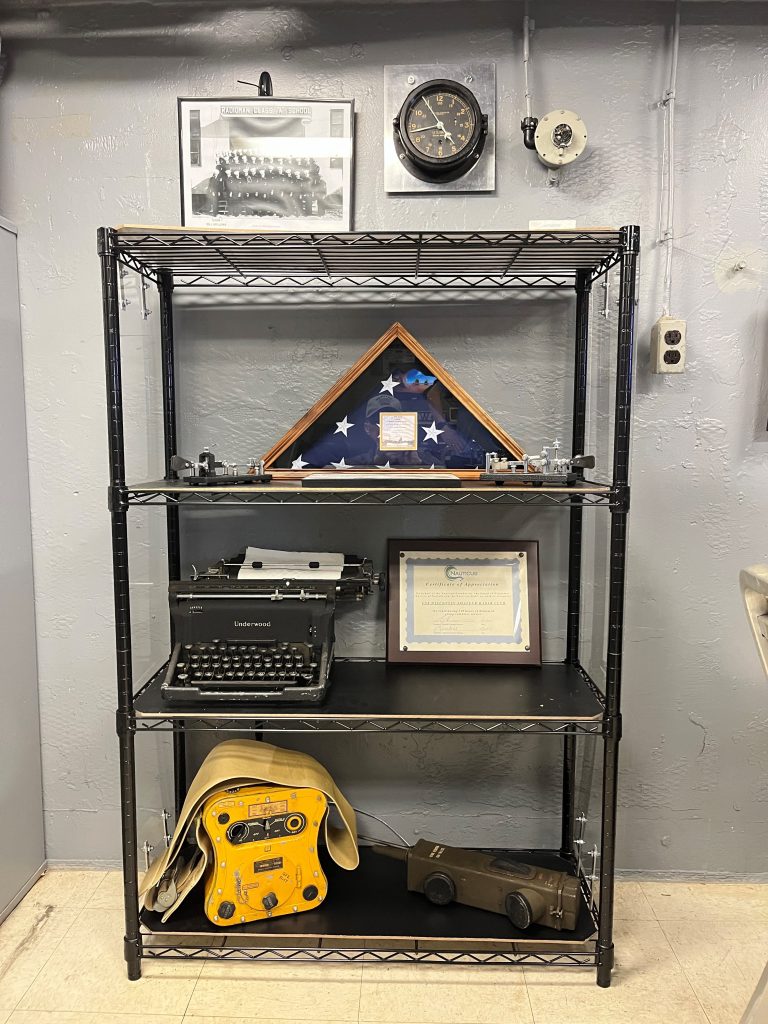
The USS Wisconsin Radio Club maintains a growing collection of historical radio artifacts that illustrate the development of radio communication and the role of Morse code in military and civilian service. These items are displayed in a dedicated exhibit case in the club’s radio shack for the enjoyment of visitors and radio enthusiasts.
Highlights of the collection include:
USS Arizona Memorial Flag – A certified commemorative flag flown over the USS Arizona Memorial. Each year the club commemorates National Pearl Harbor Remembrance Day on December 7th with a special amateur radio operating event honoring those who served.
Morse Code Keys – Two classic telegraph keys from the World War II era: a Les Logan Speed‑X bug manufactured in San Francisco and a Vibroplex J‑36 bug used by the U.S. Army Signal Corps. Both keys were carefully restored by club member Al Bianchi, K4UX.
U.S. Navy “Mill” Typewriter (Underwood) – A World War II-era typewriter used by Navy radiomen to transcribe Morse code traffic. Unlike conventional typewriters, the “Mill” produced only capital letters and included a numeral 1 and distinctive slashed zero for clarity in military message handling.
BC-611 “Handie-Talkie” – A portable World War II U.S. Army radio transceiver operating in the 3.5–6 MHz HF range, delivering about one watt of power. These compact sets allowed infantry units to maintain short-range voice communications in the field.
SCR-578 Survival Transmitter (“Gibson Girl”) – A World War II emergency transmitter carried aboard U.S. Army Air Forces and Navy aircraft. Hand-cranked for power, it transmitted distress signals on the 500 kHz international maritime distress frequency. Survivors deployed a kite or balloon to raise a 300-foot antenna, allowing signals to be received up to roughly 200 miles away. The club’s example was recovered from a B-17 bomber, includes its original box kite, and remains operational.
Visitors interested in preserving radio history are invited to contact the club’s Board of Directors regarding the donation of historical radio artifacts to the collection.